11AUG2026
By Joey Casey
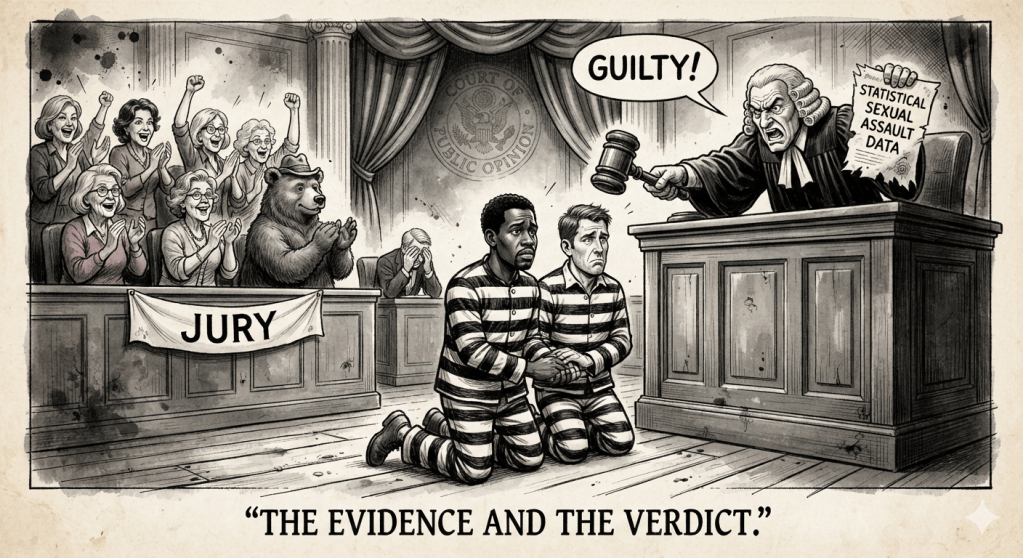
Statistics can illuminate — or obscure — the truth depending entirely on who is wielding them and why. In this piece, I want to examine what happens when data becomes a weapon rather than a tool: how P-values are gamed, how publication bias warps public understanding, and how none of it matters to a twelve-year-old girl in her final moments. This is an argument about intellectual honesty, the limits of data, and the human cost of prioritizing narrative over reality.
Who I Am, and Why That Matters
I have said it before: I am not an investigative reporter or a research PhD. I am a 41-year-old undergraduate who has learned to trust his instincts and pay attention to patterns. I am currently pursuing a Bachelor’s in Geoscience, finally chasing a childhood dream of one day being considered a scientist.
I was a nerd before it was cool — by age four, I already had a clear sense of where I wanted my life to go. Fast forward 36 years and a considerable number of side quests, and I have finally begun that journey.
I have never encountered a black man or woman who had any difficulty obtaining a driver’s license. I did, however, come to accept climate change as real — my own field of study provided compelling evidence of its existence — but that is a discussion for another day.
The Problem with Statistics
Course by course, I have worked my way through academia — entirely online — and been exposed to many differing viewpoints. Some I accepted with a measure of skepticism, such as the concept of “white privilege,” as I have never once been let off the hook for a traffic violation or received any preferential treatment simply by virtue of my race. Another perspective I rejected was the implicit suggestion that minorities are inherently less capable and require white saviors to grant them preferential treatment in order to thrive in modern society.
Or, as I have come to suspect, is it an arbitrary threshold that a researcher pulled from thin air and declared meaningful? I am referring to the P-value — a number that, if it falls below a chosen “alpha” level of significance, renders a hypothesis statistically valid. That alpha level can be anything between .01 and .10, with most researchers defaulting to .05 as a convenient middle ground.
One course I have grown to genuinely loathe — and am increasingly inclined to catalog as closer to fiction than fact — is Statistics. It has become the golden child of every DEI advocate and soft-on-crime champion, and we have afforded it far more credibility than it deserves in recent years. What actually makes something statistically significant? Is it the raw numbers? The subject matter? Perhaps the intended audience?
That is correct. The field of statistics, in practice, creates substantial room for researchers to shape narratives around predetermined conclusions. I believe we witnessed something very much like this during the COVID-19 pandemic. Many respected researchers themselves acknowledge that the science of statistics enables profoundly flawed inquiry. Variables can be added or removed to inflate or minimize an issue. Researchers can “P-hack” — running analyses repeatedly until the P-value drops below that arbitrary threshold — and then present the result as definitive truth. And then, of course, there is publication bias: a researcher conducts twenty different tests, nineteen of which fail to support the hypothesis, and only the one that “works” is published. That single result becomes the foundation of a doctoral paper and is subsequently treated as established scientific gospel.
When Numbers Fail the Victim
It is no wonder that so many people today struggle to accept hard truths even when they are staring them directly in the face. A clear example is the debate surrounding violent crime committed by undocumented immigrants. Statistical advocates argue that such crimes represent a relatively small proportion of total crime in the United States. But try telling that to the victims, or to the families of those victims — to them, no statistical threshold carries any meaning whatsoever.
The “level of significance” for a grieving family is incalculable. Meanwhile, those on the tolerant progressive left argue that the overall numbers make such tragedies an acceptable cost. The truth, however, is that beautiful and irreplaceable human lives would still be with us had they not been taken in violent and inhumane ways. Consider what Jocelyn Nungaray experienced in her final moments — bound, sexually assaulted, strangled, and discarded in a creek so that her body might never be found. She was twelve years old. She was not thinking about statistics. Her final thoughts were almost certainly not about P-values or significance thresholds.
I chose Jocelyn’s story because when I first heard it in June of 2024, my reaction came in stages. First came a visceral, consuming fury. Then came an overwhelming wave of grief for this young girl I had never met. I wept for her — a grown man, a complete stranger, brought to tears by what had been done to a child. And then came the responses: the “that’s tragic, but…” deflections from socialist commentators and migrant advocacy groups. There is no “but” that belongs anywhere near a genuine expression of condolence. That rhetorical move — the tragedy-qualifying “but” — amounts to little more than a callous dismissal: an arrogant shrug from an apparatus of division that cares nothing about the lives of everyday people and everything about maintaining its grip on narrative, policy, and authority.
“There is no ‘but’ that belongs anywhere near a genuine expression of condolence.”
Joey Casey
Sexual Assault and Demographic Data
Shifting focus to Black men, we see the inverse: Black Americans represent approximately 13.5% of the population but account for roughly 27% of all reported sexual assaults — a ratio of 2:1, indicating significant overrepresentation. Simplified: the data suggests approximately 1 in 1,000 White men will commit a sexual assault, compared to approximately 1 in 100 Black men.
Here is a statistic frequently deployed to sow racial and gender division. According to available demographic data, White Americans comprise approximately 80% of the population yet account for roughly 57% of all reported sexual assaults — a ratio of approximately 0.71:1, meaning white males are actually underrepresented relative to their share of the population. For White Americans to be equitably represented in sexual assault statistics, they would need to account for roughly 71% of all cases.
I have encountered this statistic before, and there are significant counterarguments that can — and should — be raised against it, including:
- Crimes not reported
- Wrongful convictions
- False accusations
- Age disparity among the demographics
- Relationship status
The Silence Around Male Victimization
It is easy to see, however, how numbers like these can be weaponized to manufacture racial division and cultivate a broader distrust of men as a class. What is notably absent from this data is male-on-male and female-on-male sexual assault. Men are far less likely to report being sexually assaulted than women are — and those who do come forward are, in many respects, overcoming millennia of deeply embedded sociological conditioning, risk ostracization from other men.
Unfortunately, men who report such crimes are often met not with empathy but with ridicule, stripped of their dignity through tasteless jokes and cruel characterizations. That stigma is real, pervasive, and profoundly damaging. As a result, male victimization goes unreported — sometimes for years, sometimes for decades, and sometimes men carry that shame silently to the grave. Society extends precious little compassion to the men who are so grievously violated, and that absence of empathy is a failure we should all take seriously.
Returning to racial demographics: you can present me with the numbers, but I am a white man from Los Angeles who now lives in Oklahoma, and my lived experience tells a different story. The vast majority of sexual assault cases I have personally heard about or witnessed covered in local media have involved Hispanic males and, more recently, Middle Eastern males — two demographics that are frequently grouped together under the catch-all category of “all other,” which accounts for roughly 15% of the population.
This is not an assertion that those groups are statistically more likely to commit such crimes — the data does not cleanly support that conclusion — but it is an honest account of what I have personally observed to be the most commonly reported cases. For what it is worth, I have never personally known a white or Black man who committed a sexual assault against a woman. I have, however, known one white man who perpetrated chronic and violent sexual abuse against a male child under the age of twelve — and that child was me.
Final Thoughts
What I have tried to do in this piece is not dismiss data — it is to contextualize it. Numbers matter, but they are never neutral. They are collected, filtered, categorized, and published by people with interests, blind spots, and deadlines. The stories behind those numbers — Jocelyn Nungaray, the men who never report their own abuse, the families absorbing losses that no percentage point can capture — those stories demand more from us than a shrug and a citation.
Intellectual honesty requires holding two things at once: an appreciation for rigorous inquiry, and a clear-eyed recognition of its limits. Statistics can point us toward patterns — but they cannot tell us what those patterns mean for any individual life. That judgment still belongs to us, and we should exercise it carefully.
 MensThought
Leave a comment